
Sawmill chips — parameters and use
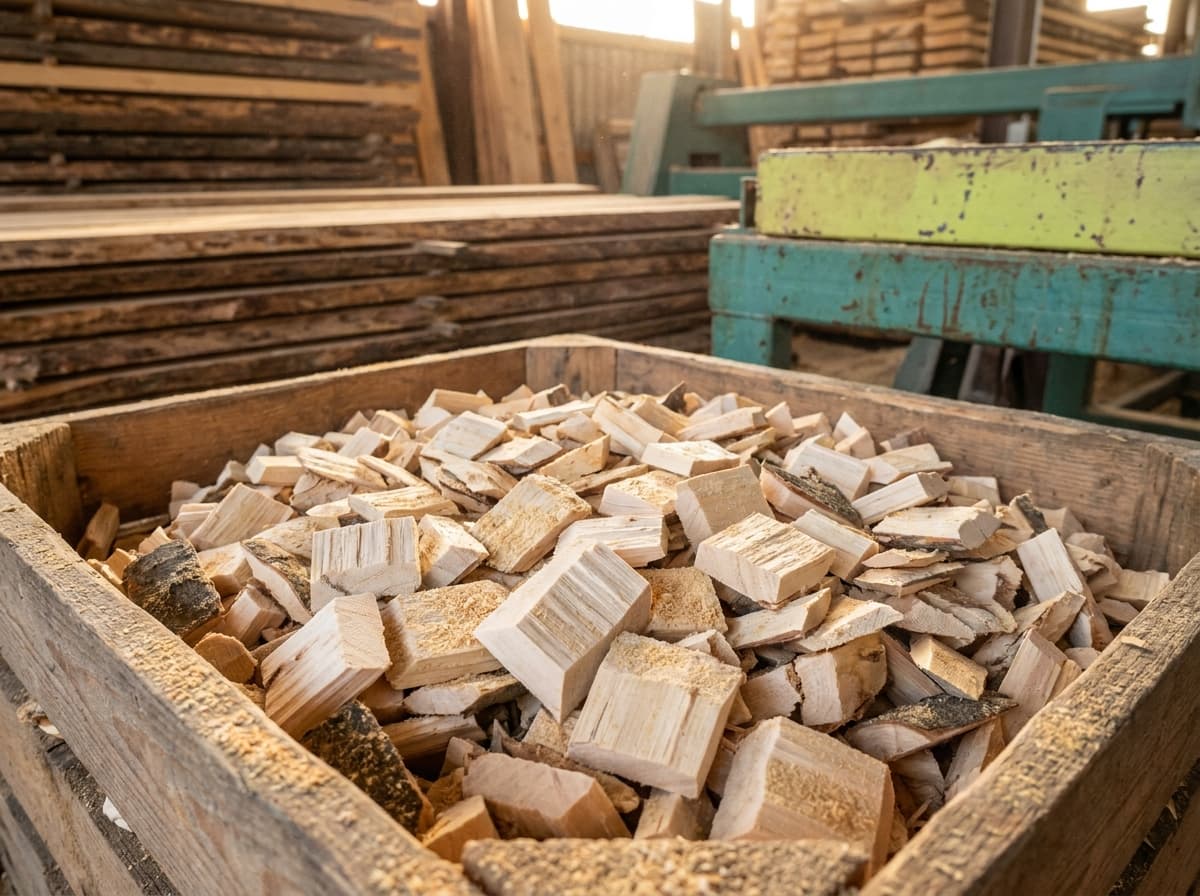
Sawmill chips arise when softwood is sawn, so the material is clean, uniform and free of bark and mineral contamination. That shows in ash below one percent and in a fine, even particle size up to 31.5 mm. Moisture of 20-25% gives 13.2-14.2 MJ/kg, the highest achievable from chips without extra drying.
We recommend this grade wherever the installation limits particle size or where you want little ash to deal with. Fine, even chips pass through screw feeders without jamming, and the absence of bark limits slagging in the combustion chamber.
| Calorific value | 13.2-14.2 MJ/kg |
| Moisture | 20-25% |
| Ash content | 0.5-1.0% |
| Particle size | up to 31.5 mm |
| Raw material | softwood sawing residues |
Photos of the cargo
Forest chips — parameters and use
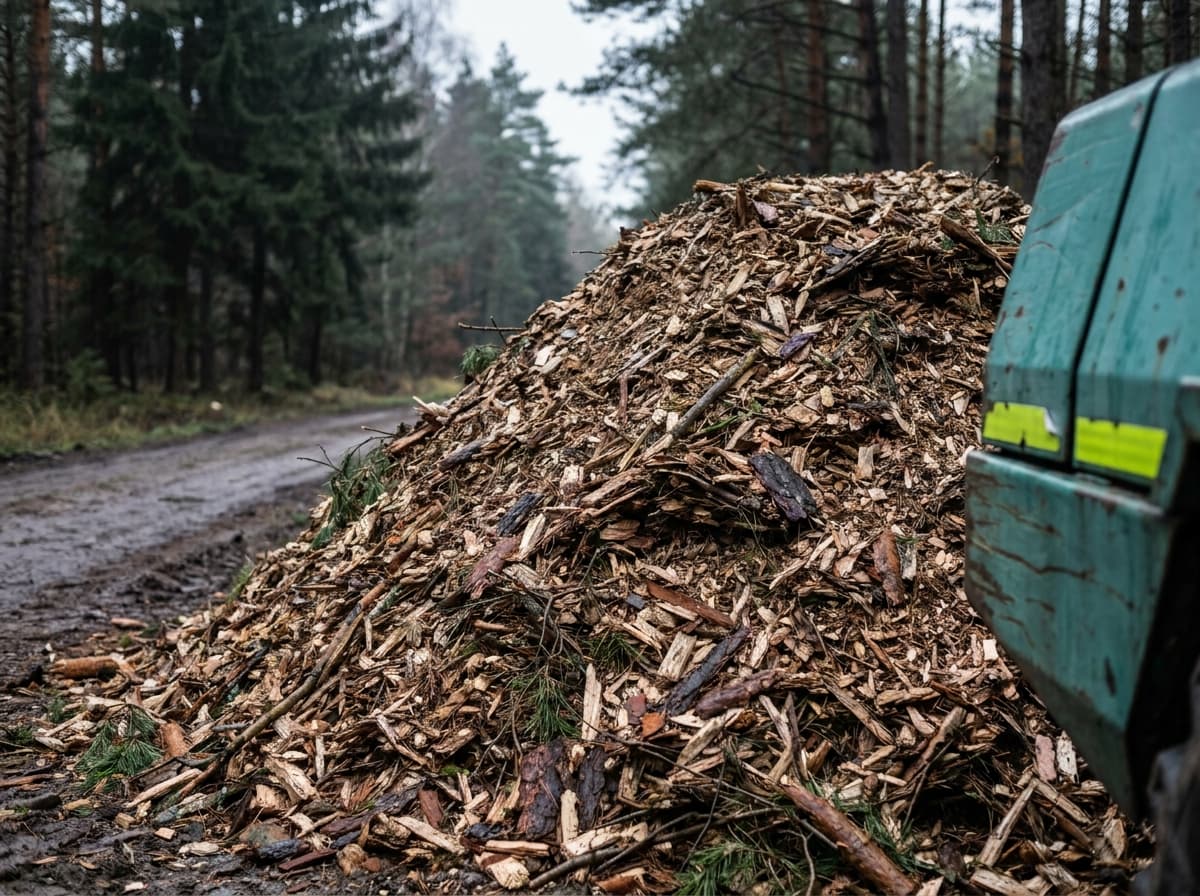
Forest chips are produced in the forest from small-diameter S2A roundwood, 7 to 25 centimetres across, and from thinning residues. The material goes into the chipper with its bark, so ash is higher at 0.9-1.4%. Particle size reaches 45 mm and moisture ranges from 25 to 40% depending on season and storage time.
This grade suits larger boiler houses with a moving or stepped grate that handle coarser, more variable fuel. Where the installation is ready for it, forest chips give the lowest cost per gigajoule of all our wood fuels.
| Calorific value | 10.2-13.2 MJ/kg |
| Moisture | 25-40% |
| Ash content | 0.9-1.4% |
| Particle size | up to 45 mm |
| Raw material | small-diameter S2A wood, thinnings |
How much wood chips do you need
Enter the tonnage or your annual energy demand — we convert one into the other and show the number of loads and the ash left to remove.
Based on 13.7 MJ/kg and 0.75% ash. Boiler efficiency is not included — these are fuel figures, not delivered heat.
Which grade to choose for your boiler house
The choice comes down to what your boiler tolerates, not to which fuel looks better in a table. With a screw feeder, lower output and a particle-size limit, take sawmill chips. With a larger grate-fired boiler and efficient de-ashing, forest chips will use its capability and cut the fuel cost.
It is also worth working out what you really pay for energy. Forest chips are cheaper per tonne, but that tonne holds more water, so you get less heat from it. At 40% moisture part of the energy goes into evaporating water and never reaches the exchanger.
Calorific value against moisture
The calorific value of chips depends above all on water content, since dry wood itself has a similar value across softwood species. Every percentage point of moisture lowers the heat you actually recover from a tonne.
Moisture matters beyond the energy sum. Wet material stores poorly, starts to ferment and cake in the pile, and in frost it freezes in the trailer and complicates unloading. For a season-long stock, sawmill chips keep better.
Tell us which grade and how many tonnes you need — we will check availability and name the collection point.
How this fuel compares with the rest
Chips and PKS are shown at mid-range, as they vary by batch. The A1 and coal figures come from test reports for specific deliveries.
Pricing chips: per tonne or per cubic metre
Two settlement methods circulate in the chip trade and it pays to check which one an offer uses. Per tonne covers mass including its water; per loose cubic metre covers volume as heaped in the trailer. The two do not convert by a simple factor, because bulk density shifts with moisture and particle size.
We settle by tonne and give the weighbridge ticket for every delivery. In the quotation we separate the price of the goods from transport, so you can compare us with other suppliers on the same basis.
Transport and unloading
We release chips in bulk on FCA terms — loaded onto the vehicle you send. The choice between a tipper and a walking-floor trailer follows from what your yard looks like. A tipper discharges by gravity and needs firm ground and clearance to raise the body. A walking floor pushes the material out horizontally, so it works where the trailer cannot be raised.
We agree unloading conditions before the first delivery, because they usually decide the vehicle and affect transport cost. Every delivery is notified in advance and confirmed before departure.
What FCA means and how it differs from DAPWood chips and S2A energy wood
The raw material for forest chips is energy wood — assortments whose parameters rule out sawing into timber. Class S2A covers small-diameter wood of 7 to 25 centimetres, mostly from thinnings. It does not compete with the sawmilling or furniture industries, because it is unsuitable for them.
This matters when accounting for the fuel as biomass and when evidencing the origin of the raw material to an auditor. If your permit or accounting system requires the assortment class, we state it in the delivery documentation.
Availability and how to enquire
We will be straight about it: chips are not currently part of our standing stock. We specialise in imported biomass and trade chips through domestic suppliers, to order rather than from the yard. So we do not promise cargo for the day after tomorrow — but we do not turn you away either.
In practice: once we have your enquiry we check availability for the parameters you need, confirm a feasible date and quote the price including transport. Repeat deliveries across a heating season are what we handle best, because that gives us time to secure volume and plan a schedule.
Four things help most in an enquiry: the grade or required fuel parameters, the estimated volume in tonnes, the expected date or delivery period, and the unloading address with a description of the yard.
Frequently asked questions
What is the calorific value of wood chips?
Sawmill chips deliver 13.2-14.2 MJ/kg at 20-25% moisture; forest chips 10.2-13.2 MJ/kg at 25-40%. The difference comes mainly from water content, since part of the energy goes into evaporating it.
How do sawmill and forest chips differ?
Sawmill chips come from softwood sawing residues: dry, fine, up to 31.5 mm, ash below 1.0%. Forest chips are made in the forest from S2A wood and thinnings, bark included, so they give 0.9-1.4% ash, reach 45 mm and carry more moisture.
Which grade should I choose?
With a screw feeder and a particle-size limit, take sawmill chips. With a larger grate-fired boiler and efficient de-ashing, forest chips will use its capability at lower fuel cost. The installation decides, not the table.
Do you settle per tonne or per cubic metre?
We settle per tonne and provide the weighbridge ticket for every delivery. Pricing per loose cubic metre can mislead, because bulk density shifts with moisture and particle size.
Which vehicle should I send and what does unloading need?
We release the goods in bulk on FCA terms and you send the vehicle — a tipper or a walking-floor trailer. For orders above 1,000 tonnes we can help arrange haulage, agreed case by case. A tipper discharges by gravity and needs firm ground and headroom; a walking floor pushes the material out horizontally and copes under a roof or inside a hall.
Are energy chips the same as garden chips?
No, they are different materials. Garden and decorative chips are for mulching beds and surfacing paths, judged on appearance and durability rather than calorific value. The chips described here are fuel for biomass boilers.
Do you have chips available immediately?
Chips are not part of our standing stock, so we handle them to order through domestic suppliers. Once we have your enquiry we check availability, confirm a feasible date and quote the price including transport. Repeat seasonal deliveries are what we serve best.